System state polling
Overview
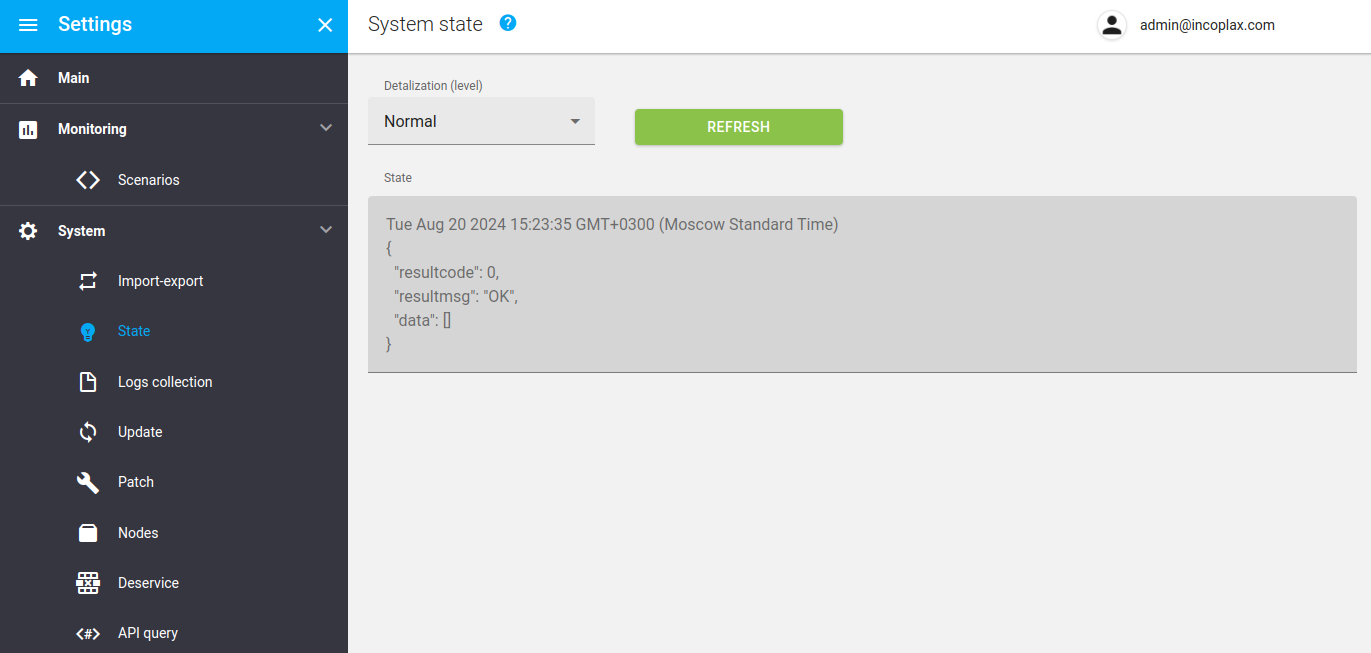
On request the platform collects state from all servers and sites and outputs all deviations from normal values.
The absence of messages in the output is the criterion for successful system self-diagnostics. In some cases informational messages may appear selectively: about increased CPU load, about a restart of some microservice instance, about exceeding the message queue size, etc.
Basically, a normal state is always accompanied by the absence of any warnings in the output. The administrator’s task is to keep the system in a normal state. The administrator decides on the need for urgent intervention based on knowledge of their system instance.
System state monitoring is performed in two ways.
Polling from the application
In the "Settings" application under the master domain administrator account, select the "System/State" section.
Polling via API
GET /api/monitor/v1/system/state HTTP/1.1HTTP/1.1 200 OK
{
"resultcode": 0,
"resultmsg": "OK",
"data": {
"certificate": [
{
"site": "main_site",
"servers": [
{
"mdc1@192.168.0.126": [
{
"status": "error",
"reason": "Certificate expired",
"domain": "incoplax.com"
},
{
"status": "error",
"reason": "Certificate expired",
"domain": "pbx.incoplax.com"
}
]
}
]
}
],
"inactive_nodes": [
{
"site": "central",
"nodes": [
"ws3@192.168.0.127",
"mg31@192.168.0.127",
"mg32@192.168.0.127"
]
}
],
"cpu_usage": [
{
"site": "central",
"servers": [
{
"server": "192.168.0.125",
"busy_percent": 67.12,
"rup_load_avg1": 6.71,
"rup_load_avg5": 5.12,
"rup_load_avg15": 3.22,
"cpu_count": 4
}
]
}
]
}
}